
A Scientific Paper Published in Scopus and Clarivate Q1
2026-04-19
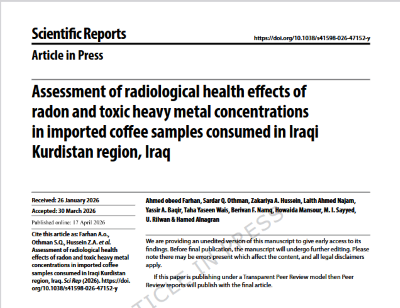
In a new scientific achievement added to the record of international academic collaboration, Assistant Professor Dr. Ahmed Obaid Farhan, a faculty member at the Renewable Energy Research Center, published a scientific paper in collaboration with a select group of researchers from prestigious universities worldwide in the scientific journal "Scientific Reports," which is indexed in Scopus and Clarivate Q1 and is considered a reputable scientific journal with an Impact Factor of 3.9. The paper is titled:
“Assessment of radiological health effects of radon and toxic heavy metal concentrations in imported coffee samples consumed in the Iraqi Kurdistan region, Iraq.” The study demonstrated that radon and toxic heavy metals in food products can cause serious health problems for consumers. This study evaluated the levels of specific heavy metals and radon in imported coffee samples consumed in the Iraqi Kurdistan region. Samples were located and collected from major markets and then analyzed using the CR-39 nuclear radiation trace detector and the RAD7 electronic radon detector. Radon activity concentrations measured by CR-39 ranged from 15.5 ± 4.96 to 48.4 ± 15.49 Bq/m³, and by RAD7 from 15.6 ± 4.99 to 44.5 ± 14.24 Bq/m³. Active radium content in the coffee samples ranged from 0.15 ± 0.05 Bq/kg to 0.47 ± 0.15 Bq/kg. Accordingly, the annual effective dose resulting from ingestion was calculated to be between 197.1 ± nSv/year and 617.58 ± 197.63 nSv/year. Both parameters remained well below internationally recommended safety limits. The concentration of toxic metals in the coffee samples—cadmium, lead, nickel, zinc, potassium, copper, calcium, and sodium—ranged from undetectable levels to 45 mg/kg, while heavy metal levels did not exceed regional or international food safety standards. Prolonged consumption of these coffee samples could contribute to cumulative heavy metal exposure. This study highlights the need for regular monitoring to ensure food safety and protect public health in the region.




