|
A scientific paper published in Scopus (Q1)
2026-05-05
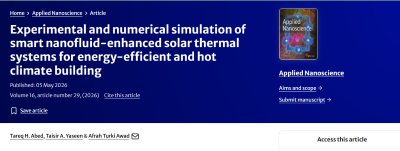
Assistant Lecturer Tariq Hamad Abdul, a faculty member at the Renewable Energy Research Center, University of Anbar, published a scientific paper in the international journal "Applied Nanoscience," indexed in Scopus with an impact factor of 7.8 in the second quartile (Q1). The paper is titled:
“Experimental and numerical simulation of smart nanofluid-enhanced solar thermal systems for energy-efficient and hot climate building.” The study investigated the thermal performance of nano-flat solar collectors in extremely hot climates. The study was conducted experimentally and numerically using Baghdad, Iraq, as a case study. Three working fluids at 1% by volume were experimentally investigated: aluminum oxide-water (NF1), yttrium oxide-water (NF2), and a hybrid mixture of aluminum oxide/yttrium oxide-water (NF3). The collector's performance was significantly improved using the nanofluid compared to water. Under the same conditions, an increase in the outlet temperature of 1.2°C and 3°C was achieved. The temperature difference was 4°C (compared to water) for NF1, NF2, and NF3, respectively, attributed to improved effective thermal conductivity and heat transfer. The thermal efficiency of the nanofluids was at its best during the morning-afternoon period, ranging from 0.50 to 0.762, demonstrating an approximately 27% improvement in useful heat gain compared to water. A steady-state model based on the Hötel-Wheeler equation was constructed using MATLAB/Simulink, relying on actual hourly NASA POWER climate data, to describe harsh summer conditions (global solar irradiance ≈ 1000 W/m², ambient temperature > 42°C). Good agreement was observed between the experimental and simulation data, with a maximum difference of less than 6.5%. Furthermore, these stability tests confirmed the robustness, with the hybrid nanofluid exhibiting the highest level of stability over a month. All results indicate that hybrid nanofluids are capable of providing significantly better performance for solar collectors in Extremely hot weather conditions.
|